Faith Alone---The Doctrine of Justification: What the Reformers Taught...and Why It Still Matters (The Five Solas Series) by Thomas R. Schreiner
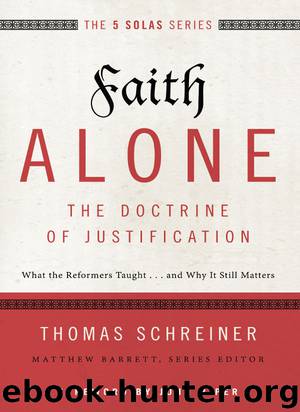
Author:Thomas R. Schreiner [Schreiner, Thomas R.]
Language: eng
Format: azw3
Tags: ebook
Publisher: Zondervan
Published: 2015-09-15T04:00:00+00:00
1. Brian Vickers, Justification by Grace through Faith: Finding Freedom from Legalism, Lawlessness, Pride, and Despair (Phillipsburg, NJ: Presbyterian & Reformed, 2013).
2. In defense of such a view in Isaiah 40 – 55, see Douglas J. Moo, “Justification in Galatians,” in Understanding the Times: New Testament Studies in the 21st Century: Essays in Honor of D. A. Carson on the Occasion of His 65th Birthday (Wheaton, IL: Crossway, 2011), 174.
3. Rightly, ibid., 172.
4. Mark A. Seifrid, “Righteousness Language in the Hebrew Scriptures and Early Judaism,” in Justification and Variegated Nomism: Volume 1 — The Complexities of Second-Temple Judaism (ed. D. A. Carson, Mark A. Seifrid, and Peter T. O’Brien; Grand Rapids: Baker, 2004), 415 – 42.
5. For a full defense of the centrality of covenant in biblical theology, see Peter J. Gentry and Stephen J. Wellum, Kingdom through Covenant: A Biblical-Theological Understanding of the Covenants (Wheaton, IL: Crossway, 2012).
6. So Wright, Justification, 64 – 71. Against this, see Seifrid, “Righteousness Language in the Hebrew Scriptures and Early Judaism,” 415 – 42; idem, Christ, Our Righteousness, 38 – 45.
7. Moo rightly notes that covenant membership and justification may be closely related without being identical (“Justification in Galatians,” 175).
8. Bird rightly critiques Seifrid, who separates righteousness altogether from the covenant, but Bird goes too far in defining righteousness as covenant faithfulness (Saving Righteousness of God, 35 – 39).
9. John Piper, The Future of Justification: A Response to N. T. Wright (Wheaton, IL: Cross, 2007), 62 – 71; idem, The Justification of God: An Exegetical and Theological Study of Romans 9:1 – 23 (2nd ed.; Grand Rapids: Eerdmans, 1993), 111 – 18.
10. Wright correctly critiques Piper at this point (Justification, 66 – 68).
11. For a very helpful study of the word righteousness, see Westerholm, Justification Reconsidered, 51 – 74.
12. See, e.g., Gerhard von Rad, Old Testament Theology (trans. D. M. G. Stalker; 2 vols.; New York: Harper & Row, 1962, 1965), 1:370 – 83; James D. G. Dunn, Romans 1 – 8 (WBC; Dallas: Word, 198), 40 – 43; idem, “The Justice of God,” 16 – 21; J. A. Ziesler, The Meaning of Righteousness in Paul: A Linguistic and Theological Enquiry (SNTSMS 20; Cambridge: Cambridge University Press, 1972), 34 – 43; P. R. Achtemeier, “Righteousness in the NT,” IDB 4:91 – 99.
13. See Seifrid, “Righteousness Language in the Hebrew Scriptures and Early Judaism,” 415 – 24; idem, Christ, Our Righteousness: Paul’s Theology of Justification (NSBT 9; Downers Grove, IL: InterVarsity Press, 2004), 38 – 45.
14. Piper says that righteousness isn’t conformity to a norm because the standard isn’t always distributive justice (Justification of God, 105 – 8). Such a statement is correct, but the standard is God’s own character, so that God’s character is the norm.
15. Bird posits a both – and, so that righteousness means both right relationship within the covenant and conformity to a norm (Saving Righteousness of God, 10 – 12). Such an answer isn’t so much incorrect as it is incomplete, for it doesn’t answer the question about the foundation of the norm in the covenant relationship.
Download
This site does not store any files on its server. We only index and link to content provided by other sites. Please contact the content providers to delete copyright contents if any and email us, we'll remove relevant links or contents immediately.
The Secret Power of Speaking God's Word by Joyce Meyer(3165)
Signature in the Cell: DNA and the Evidence for Intelligent Design by Stephen C. Meyer(3125)
Real Sex by Lauren F. Winner(3006)
The Holy Spirit by Billy Graham(2942)
The Gnostic Gospels by Pagels Elaine(2525)
Jesus by Paul Johnson(2351)
Devil, The by Almond Philip C(2324)
23:27 by H. L. Roberts(2245)
The Nativity by Geza Vermes(2226)
Chosen by God by R. C. Sproul(2159)
All Things New by John Eldredge(2157)
Angels of God: The Bible, the Church and the Heavenly Hosts by Mike Aquilina(1952)
The Return of the Gods by Erich von Daniken(1927)
Angels by Billy Graham(1920)
Knowing God by J.I. Packer(1851)
Jesus of Nazareth by Joseph Ratzinger(1802)
The Gnostic Gospel of St. Thomas by Tau Malachi(1781)
Evidence of the Afterlife by Jeffrey Long(1776)
How To Be Born Again by Billy Graham(1775)
